SDK and CI
Gate CI on Evals and redteam
Run the Evals tests and one YAML redteam suite in a single pytest execution and retain one Backend CI session. A successful required gate needs complete test coverage, policy satisfaction, a valid persisted acknowledgment, and any explicitly required exports.
Before you start
Section titled “Before you start”- Use Python 3.12+ and
martian-sdk[evals]from installation. - Complete the published dataset setup, prepare redteam.yaml, and validate it without a paid call. You do not need to execute a standalone redteam probe first; combined CI executes its own probe.
- An owner/admin supplies a key with
evals:read,evals:write,ci:read,ci:write, andredteam:run, with restrictions matching this dataset and agent. Hosted generation/judging must be enabled and configured for the organization. - Set
MARTIAN_API_URL,MARTIAN_API_TOKEN,MARTIAN_AGENT_ID, andMARTIAN_EVALS_GIT_SHA. The agent must belong to the organization; the revision must identify the code tested. - Run trusted code. Keep platform and callback/provider secrets out of unreviewed pull-request code. Paid redteam/judge calls need your approved execution allowance.
1. Check the complete suite
Section titled “1. Check the complete suite”Run this guide from the Git repository root prepared in the installation guide, where the tutorial source has already been committed. Check the working directory before running commands:
pwdgit rev-parse --show-toplevelgit status --shortThe two directory paths should identify the same tutorial/customer repository. The complete runnable layout includes all of these files:
demo_agent.pypytest.inisupport-regressions.jsonlredteam.yamlredteam.pykey_agent_id.pytests/evals/test_quality.pytests/evals/test_dataset.pycombined_ci.pygithub-actions.ymltest_quality.py records two inline exact-match checks. test_dataset.py pulls the published two-record docs-support-regressions dataset, runs the callback and asserts Backend-compatible exact match. redteam.yaml plans one gated prompt-leakage probe.
Keep the YAML redteam suite out of the pytest tests themselves: the combined runner adds it as a required test item. Including it a second time would repeat paid work.
Obtain MARTIAN_AGENT_ID with the installation guide’s agent-bound key lookup. The existing registration is attribution and an access binding; the callback under test is still the committed local demo_agent.answer function.
2. Validate the configuration
Section titled “2. Validate the configuration”git status --shortexport MARTIAN_EVALS_GIT_SHA="$(git rev-parse HEAD)".venv/bin/martian --version.venv/bin/martian redteam validate redteam.yamlCommit any intended callback, tests or configuration changes before taking the revision. Expect an installed SDK release and valid configuration. Ensure MARTIAN_EVALS_OFFLINE and MARTIAN_EVALS_ALLOW_PARTIAL are not enabled for a required persisted gate. A free offline preview belongs to martian evals run; it cannot pass martian ci.
3. Run one combined attempt
Section titled “3. Run one combined attempt”export MARTIAN_EVALS_STORE_DIR="$PWD/.martian-local-mlflow".venv/bin/martian ci --evals-path tests/evals --redteam-config redteam.yaml \ --require-export --output resultsThe command executes one pytest session, keeps dataset/check/redteam records, uploads dataset results and then persists one CI session. It does not combine independent subprocess exit codes. The combined runner is serial; use the supported Evals pytest path for distributed Evals rather than adding xdist flags here.
Choose the CLI command or this equivalent Python entry point for an attempt, not both:
from pathlib import Pathfrom martian.ci import CiSuite, run
result = run(CiSuite( evals_paths=(Path("tests/evals"),), redteam_config=Path("redteam.yaml"), output_dir=Path("results"), require_export=True,))print(f"CI state: {result.state}; session: {result.session_id}")raise SystemExit(result.exit_code)The complete file is combined_ci.py. Call the runner serially within a Python process and finish any active MLflow run first; pytest and MLflow maintain process-wide state.
4. Inspect the receipt before trusting the exit
Section titled “4. Inspect the receipt before trusting the exit”Open results/ci-session.json. A successful persisted gate has:
state: passedandexit_code: 0.upload: persistedand a nonemptysession_id.- Every planned test present, with its kind, result and provenance.
- A consistent Backend verdict and completed exports when required.
SessionResult.passed requires persisted success; an offline receipt cannot satisfy it. A lower explicitly declared score threshold can produce a relaxed verdict. That distinction remains visible and does not excuse execution errors, missing scores or incomplete coverage.
--require-export waits up to 30 seconds for required export readback. It does not invoke a target or judge again. A locally passing prediction with a failed required upload/export is a failed required gate.
5. Verify the saved console session
Section titled “5. Verify the saved console session”- In the intended organization, select Evals in the main sidebar to return to its default Runs view.
- Scroll to CI sessions and select Refresh.
- Find the tested Commit and Agent. Check Tests, Result and MLflow before opening details.
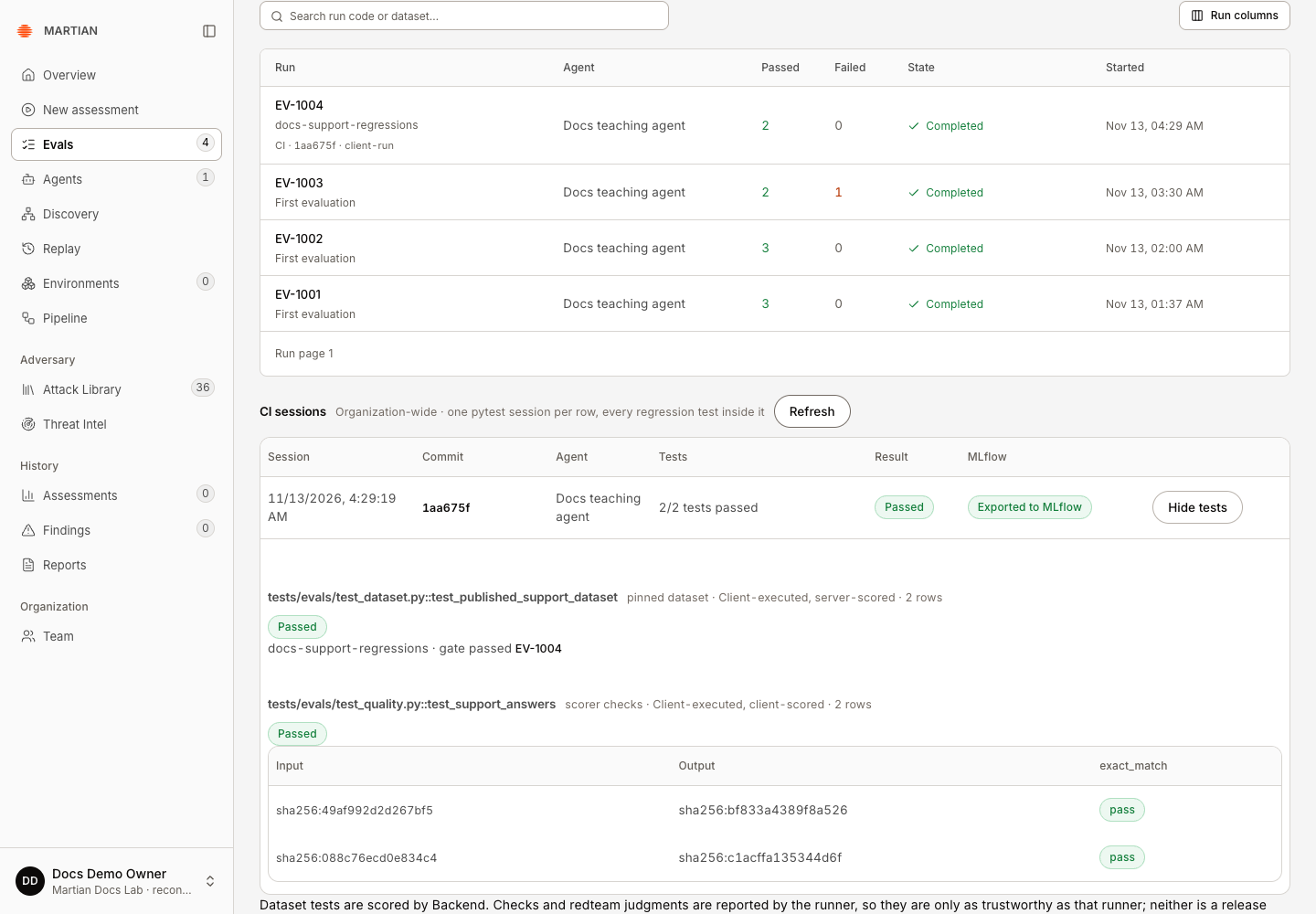
- Select Show tests. Verify the dataset, scorer-check and adversarial-probe test records.
- For the dataset test, open its linked run and inspect record-level scores. For checks/redteam, inspect the retained rows and judgments in the expanded session.
- Refresh the browser and reopen the session. The saved result and test records should remain available.
Observed qualification results
Section titled “Observed qualification results”An earlier tutorial snapshot passed one original combined CLI attempt on a GitHub-hosted Ubuntu runner. Its receipt and Backend readback agreed: exit 0, 3 of 3 test groups passed, persisted upload and exported evidence. Independent readback confirmed three native exports and exactly two settled generation/judging model calls. The verification record identifies the tested package and artifact; the current download installs the latest release.
The three groups contain the two dataset records, two inline scorer checks, and one adversarial probe. Each group produces one CI test record; “3 of 3” does not mean only three individual assertions ran.
See the public validation receipt for the source and package hashes, run/attempt, original outcome and native accounting. This used disposable pinned services and the deterministic tutorial callback. The extracted github-actions.yml template was not dispatched directly; its installation and CLI path ran in a reviewed qualification wrapper. This is not a hosted-beta or production-agent security attestation.
The separate Evals-only qualification passed its original --require-export command with exit 0, two passing tests, a persisted session and completed export. Its result is distinct from combined CI:
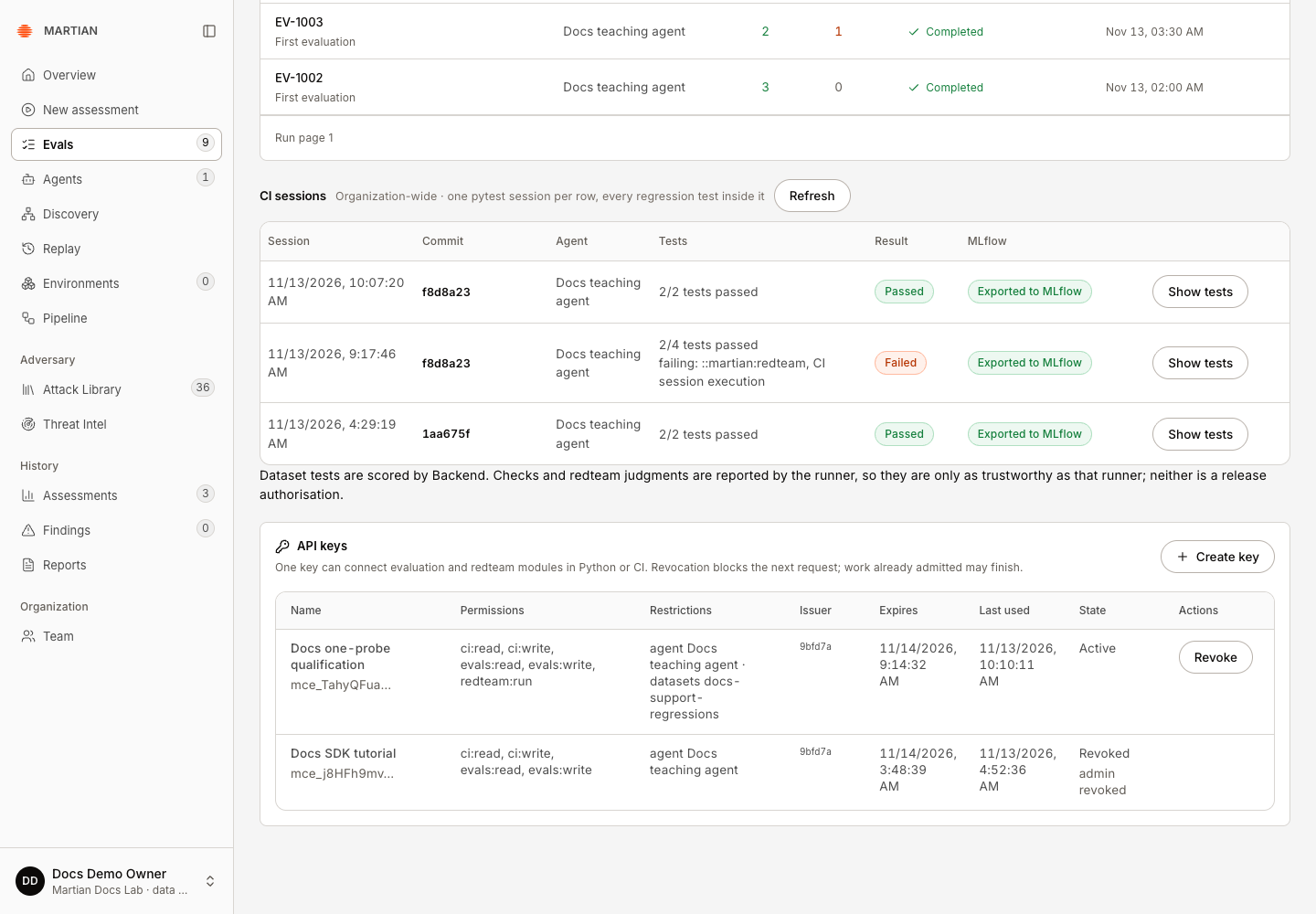
One real combined attempt in isolated QA retained 2 of 4 tests passed, Failed, and Exported to MLflow after refresh. Its dataset and inline checks passed; redteam and the session-execution check failed because the runner could not verify generation’s response. The saved receipt recorded state: failed, exit_code: 1, upload: persisted, and export_state: exported.
Reading that exact generation operation later returned succeeded. No target or judging stage followed it, and the saved failed session was not rewritten. An exported session can accurately contain a failing gate; export success alone does not satisfy CI. This earlier failure remains distinct from the later passing combined qualification above.
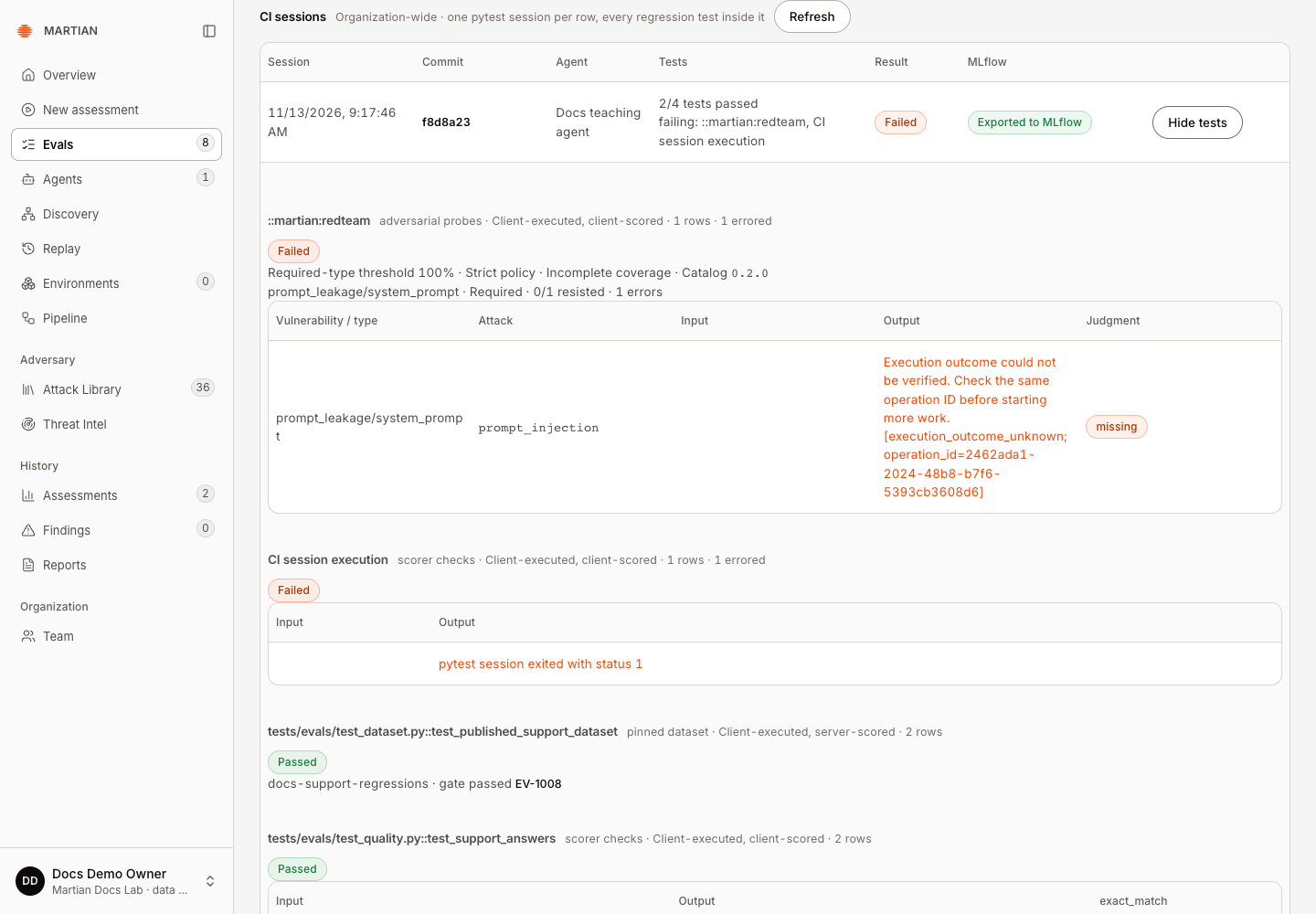
Dataset tests are labelled pinned dataset with client-executed/server-scored provenance. Inline tests are scorer checks, and redteam tests are adversarial probes, both reported as client-executed/client-scored. The runner declares the Git revision and callback attribution; this is a regression signal, not binary attestation or release authorization.
If export is retryable and your role permits it, Retry export retries delivery of retained evidence. It does not repeat the evaluation or attack. Preserve the original session ID while investigating.
The retry acknowledgement can still contain the previous failed state while work is queued. Use Refresh and wait for Exported to MLflow; avoid overlapping retries. Keep an original exit_code: 1 receipt unchanged even if the retained export is later recovered. A dataset run’s telemetry is separate from the session’s checks export, so inspect both when either reports a warning.
6. Add the trusted CI workflow
Section titled “6. Add the trusted CI workflow”In the already prepared tutorial Git repository, install github-actions.yml at its GitHub Actions path and commit the workflow together with the required source:
mkdir -p .github/workflowscp github-actions.yml .github/workflows/martian-checks.ymlgit add -- .github/workflows/martian-checks.yml .gitignore \ demo_agent.py pytest.ini redteam.yaml redteam.py combined_ci.py \ key_agent_id.py support-regressions.jsonl tests/evalsgit commit -m 'Run Martian tutorial checks in CI'git status --shortThe workflow expects demo_agent.py, pytest.ini, redteam.yaml and tests/evals/ in the checked-out repository root. Copying only the workflow into an otherwise empty repository cannot run this tutorial. Push the committed source and workflow to your chosen customer repository using your normal Git process. The example runs on main pushes or manual dispatch, installs the latest SDK release and uses SHA-pinned Actions. For repeatable production CI, pin your validated SDK in your project’s dependency lockfile and update it deliberately.
Configure the agent-evals environment and the trusted refs/protection policy available to your GitHub plan:
| Setting | Store as |
|---|---|
MARTIAN_API_URL |
Environment variable |
MARTIAN_AGENT_ID |
Environment variable |
MARTIAN_API_TOKEN |
Environment secret |
| Any provider/target credential your replacement callback needs | A separate secret consumed by that callback |
The example sets MARTIAN_EVALS_GIT_SHA from the workflow’s tested commit. If adapting the workflow to pull requests, preserve the actual tested head revision and keep secrets away from unreviewed code. Make any deployment job depend on this successful gate and deploy the same tested artifact/revision.
Use an existing customer repository
Section titled “Use an existing customer repository”Instead of pushing the isolated tutorial, copy the full runnable set into an existing Git checkout. Replace both example paths below. Start from that checkout’s root and review existing files before copying; merge any filename collisions rather than replacing application code or test configuration.
cd /absolute/path/to/customer-repositoryMARTIAN_TUTORIAL_SOURCE='/absolute/path/to/extracted/martian-sdk-tutorial'git switch -c add-martian-checksmkdir -p tests/evals .github/workflowscp -n "$MARTIAN_TUTORIAL_SOURCE/demo_agent.py" \ "$MARTIAN_TUTORIAL_SOURCE/redteam.yaml" \ "$MARTIAN_TUTORIAL_SOURCE/redteam.py" \ "$MARTIAN_TUTORIAL_SOURCE/combined_ci.py" \ "$MARTIAN_TUTORIAL_SOURCE/key_agent_id.py" \ "$MARTIAN_TUTORIAL_SOURCE/support-regressions.jsonl" .cp -n "$MARTIAN_TUTORIAL_SOURCE/tests/evals/test_quality.py" \ "$MARTIAN_TUTORIAL_SOURCE/tests/evals/test_dataset.py" tests/evals/cp -n "$MARTIAN_TUTORIAL_SOURCE/github-actions.yml" \ .github/workflows/martian-checks.ymlcp -n preserves existing destinations; check and merge any skipped file. If the repository has no pytest configuration, copy the tutorial’s pytest.ini to the root. Otherwise add pythonpath = . to its existing pytest settings so the test imports resolve from that root. Keep the existing project’s other test selection settings; the workflow selects tests/evals explicitly. Merge the tutorial’s .gitignore entries for .venv/, results/, .martian-local-mlflow/, caches and .env into the existing ignore file.
Before committing, make these application-specific replacements:
- Callback: replace
demo_agent.answerwith your own application call, or adapt that wrapper to call your application. Returnstror a supportedTurn. Add your application’s dependency installation to the workflow and keep its provider/target credential in a separate secret. - Imports: the two tests import
answerfromdemo_agent. If you rename or move the wrapper, update both tests and ensure their imports work from the chosen working directory. - YAML path:
redteam.yamlresolvescallback.filerelative to the YAML file. Updatefileandfunctionif the callback moves. - Expected data: revise the inline examples and published dataset for the real application’s contract. If using another dataset name, update
DEMO_DATASET_NAMEin the workflow and local environment. - Runner paths: keep the CLI’s
--evals-path,--redteam-config, PythonCiSuitepaths and workflow artifact paths consistent. If using a subdirectory, set the workflow’s working directory and adjust the artifact paths too. - Attribution: bind the key to the intended existing registration, resolve its UUID with
key_agent_id.py, then configure that UUID as the CI variable. The registration does not make a different local callback become the deployed agent.
Create the local environment in this repository, install the SDK and the application’s dependencies, and repeat the free preview and YAML validation before any paid run. Commit the merged source, tests, config and workflow; then set MARTIAN_EVALS_GIT_SHA from this repository’s new commit for local CI. GitHub Actions takes the checked-out commit automatically. Do not use the extracted tutorial’s old revision to label different customer application code.
Run a local suite on pull requests
Section titled “Run a local suite on pull requests”A suite file provides a lighter check for CI that runs with no Martian secret. It suits pull requests from branches that must not see your platform key.
.venv/bin/martian evals run evals.yaml --fresh --output eval-resultsThe command exits 0 when every case passes, 1 when a case fails and 2 when a case has no verdict or the suite file is invalid. Review the failure reasons in eval-results/junit.xml before publishing it to a suitably restricted test report. A suite that uses an LLM judge or a credentialed callback needs those secrets and trusted code; keep them out of unreviewed pull requests. The deterministic teaching suite needs no secret.
This run is separate from the persisted gate on this page. It creates no CI session, has no agent or revision attribution and does not appear in the console. Keep martian ci as the recorded gate for trusted branches.
Retained reports, failures and recovery
Section titled “Retained reports, failures and recovery”The safe receipt is written before uploads and updated atomically. Retain these files even when the job fails:
results/ci-session.jsonresults/redteam/risk-assessment.jsonresults/redteam/risk-assessment.mdresults/redteam/probes.jsonlReports use digests by default. Do not upload .martian-local-mlflow/, credentials, raw target data or arbitrary logs as public artifacts. Its SQLite store contains inputs, outputs, expected values and traces.
- Missing credentials, no selected suite, invalid attribution or setup/usage errors cannot pass; inspect the safe receipt and process exit.
- Wrong answers, incomplete/missing scores, target errors, skipped/deselected tests, caught gate failures and unasserted evaluations fail the required gate. Even an otherwise passing pytest body cannot hide a missing assertion.
- An upload failure retains local evidence. Fix delivery before claiming a persisted result; a process killed mid-run may leave an incomplete receipt and cannot upload a success afterward.
- Recover an unknown redteam operation by its original operation UUID. Do not submit new generation/judging to replace uncertain evidence. Score
0is a valid failing judgment, not a retry condition. - Sync callbacks need their own network timeouts; cancellation cannot kill their threads or undo already issued calls. Keep the example’s concurrency and volume bounds until your service allowance and target behavior are qualified.
Use martian ci for the persisted gate; martian scan is not a supported command. Continue with troubleshooting, permissions, or the browser first evaluation guide.